Is creativity an innate ability? Can it be learned, unlocked, strengthened or further developed? Are there practices and ways of working that foster creative thinking? The answer is yes — on all counts.
Creative practice, the generation of ideas for innovation, whether for new products or for original improvements to existing processes, has become an essential challenge across many fields. For those working in the creative professions, however, it is more than a valuable skill — it forms the very foundation of their practice.
Moreover, creativity is widely regarded as one of the core Future Skills, alongside problem-solving, entrepreneurial thinking and initiative, adaptability, and resilience (see Stifterverband / McKinsey, 2019).
In my courses, I introduce students to a wide range of creativity techniques. These include foundational methods such as brainstorming, mind mapping and various visualization approaches, as well as combinatorial techniques such as S.C.A.M.P.E.R. + X.
SCAMPER is an acronym: S stands for Substitute, C for Combine, A for Adapt, M for Modify, P for Put to other uses, E for Eliminate, R for Rearrange—and X… I’ll come back to that later.
Mithilfe einer Reihe von öffnenden Fragen können Ideen, die im brainstorming entwickelt worden sind, verwandelt, verfielfältigt und innoviert werden. Denn viele Ideen erhöhen die Chance, DIE Idee zu entwickeln, die umsetzbar, finanzierbar, annehmbar, nützlich, wirklich innovativ ist – all die Kriterien erfüllt, die im jeweiligen Projekt eine Rolle spielen.
And this is how S.C.A.M.P.E.R. + X works
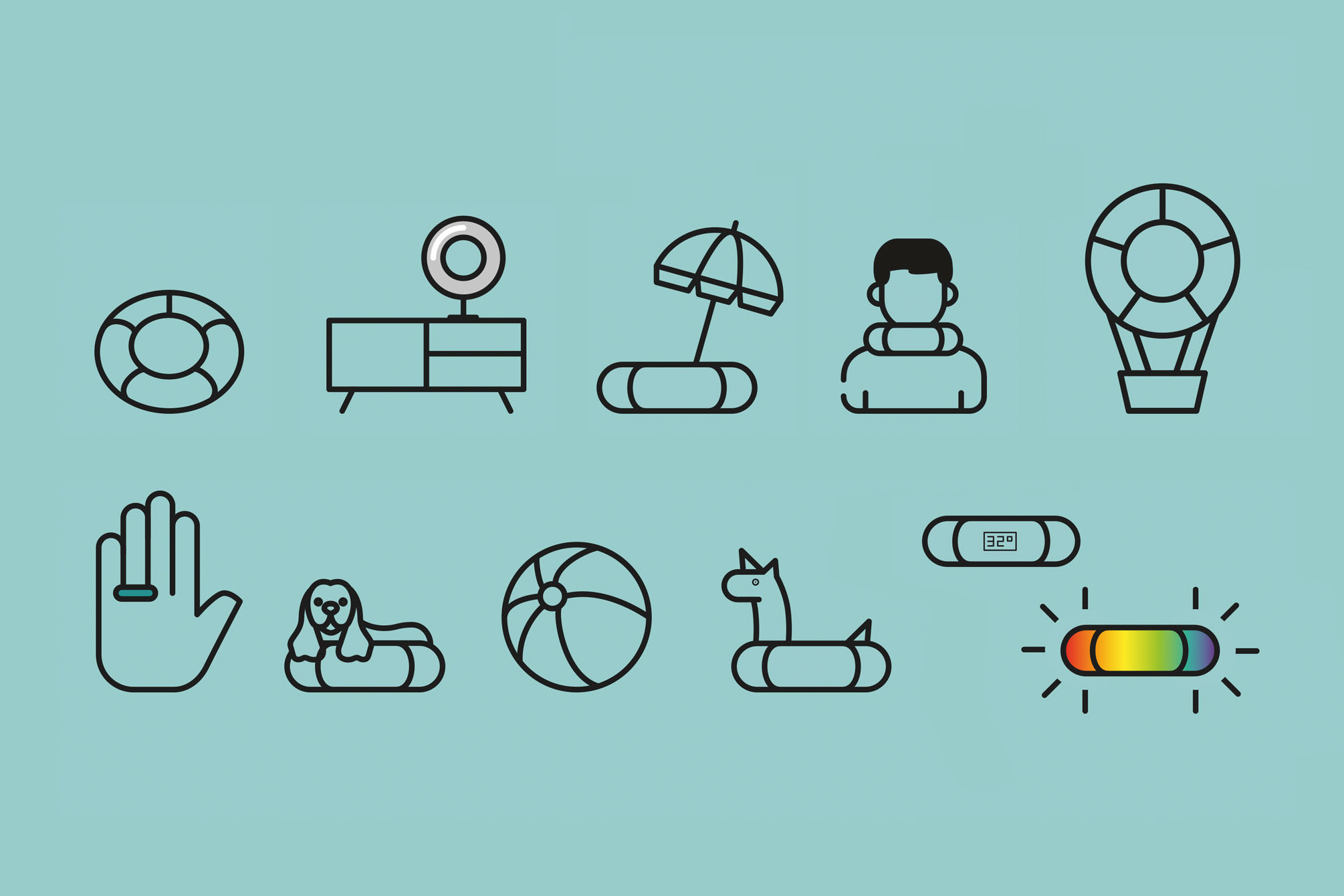
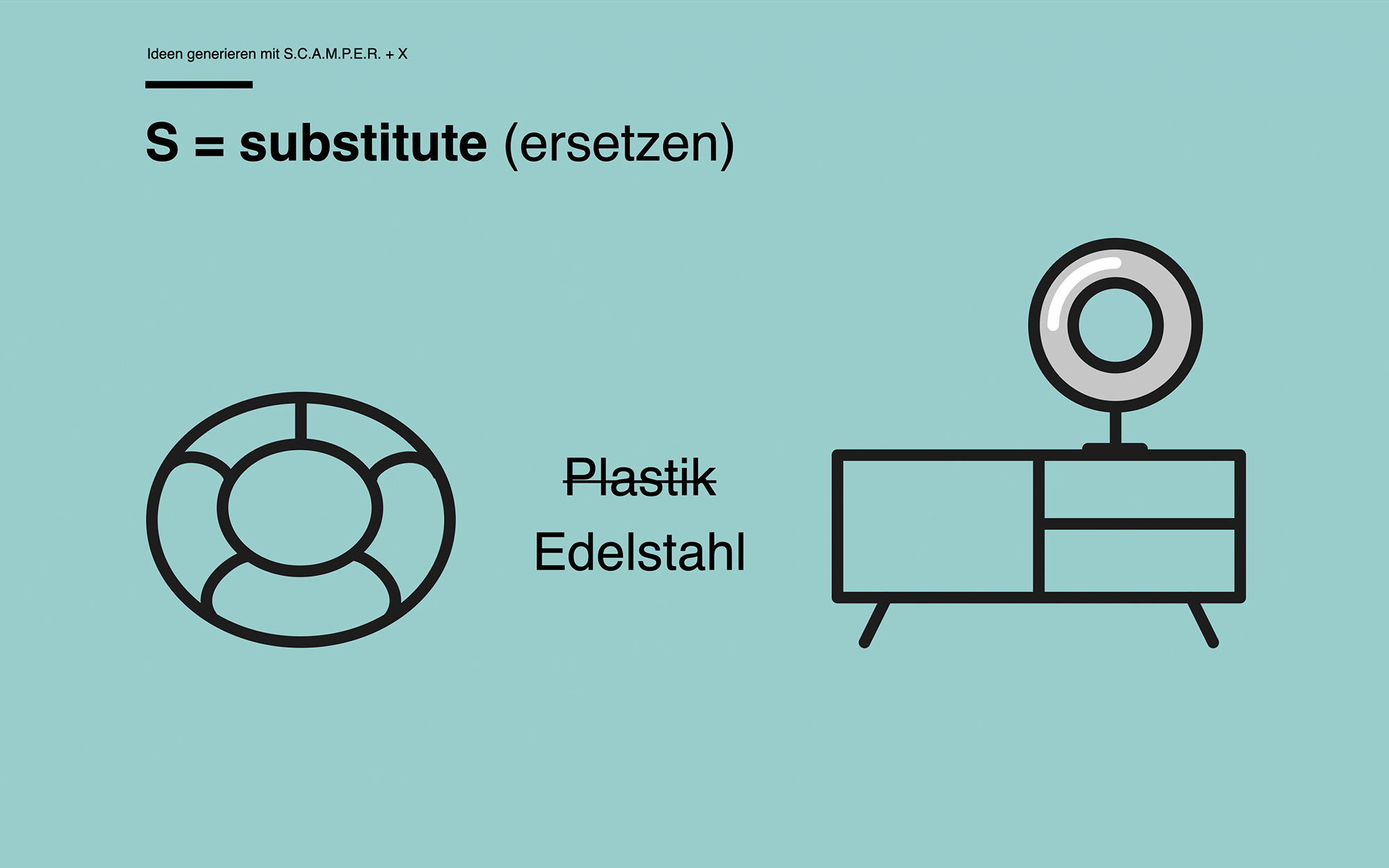
Imagine the idea to be developed is: a turquoise inflatable plastic swim ring. The S in SCAMPER stands for Substitute. The guiding questions are: What could be replaced? What could be used instead? What alternative material might be suitable? By substituting the plastic with stainless steel, the swim ring is transformed into a sculpture.

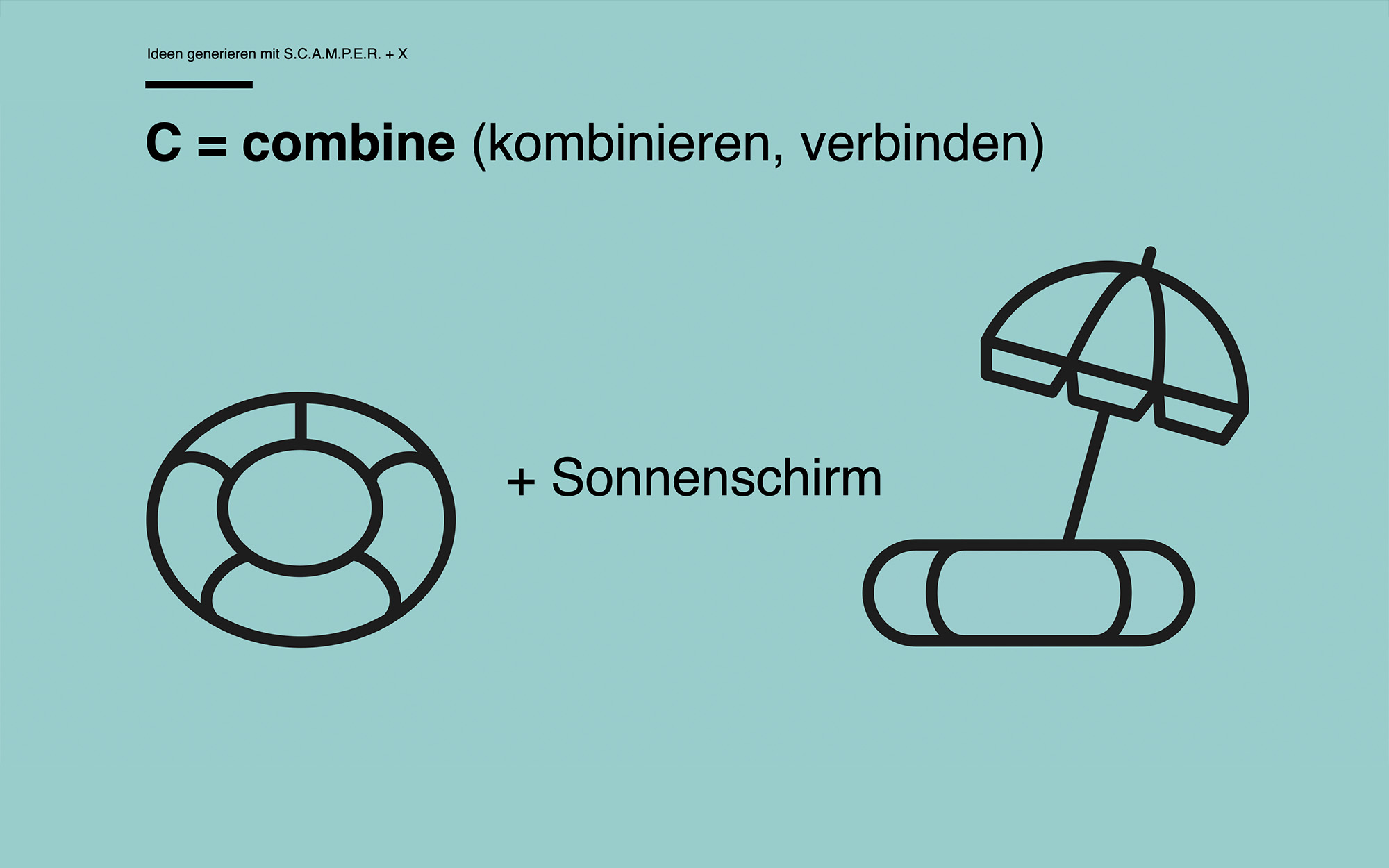
C stands for Combine. What can be combined? Which additional functions are possible? Which purposes can be merged? A swim ring combined with a sunshade.
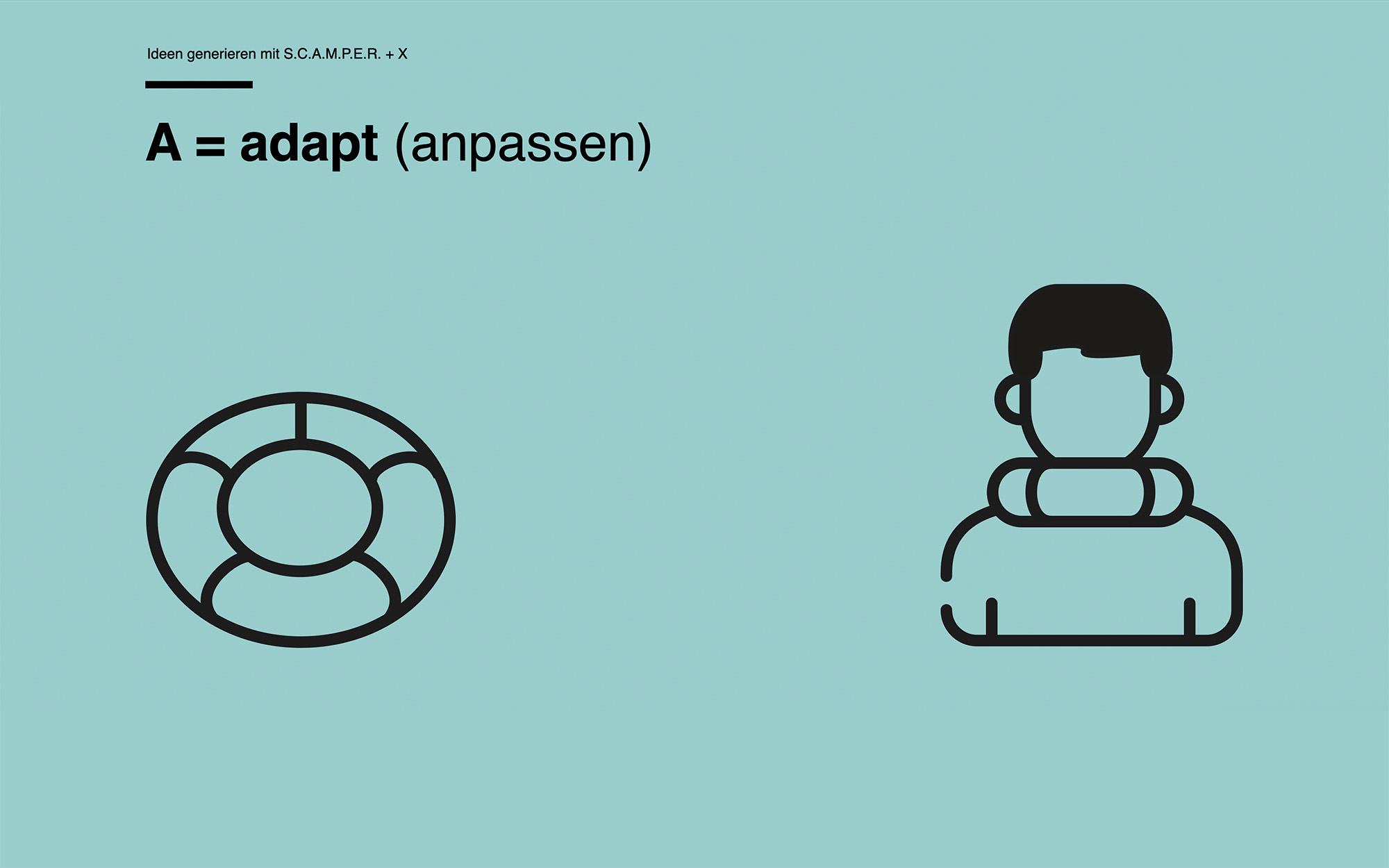
A stands for Adapt. What other ideas does the object suggest? Is there something similar that could be applied to the existing task? Can the object be adapted for a different use or benefit? A scarf, a seat cushion.
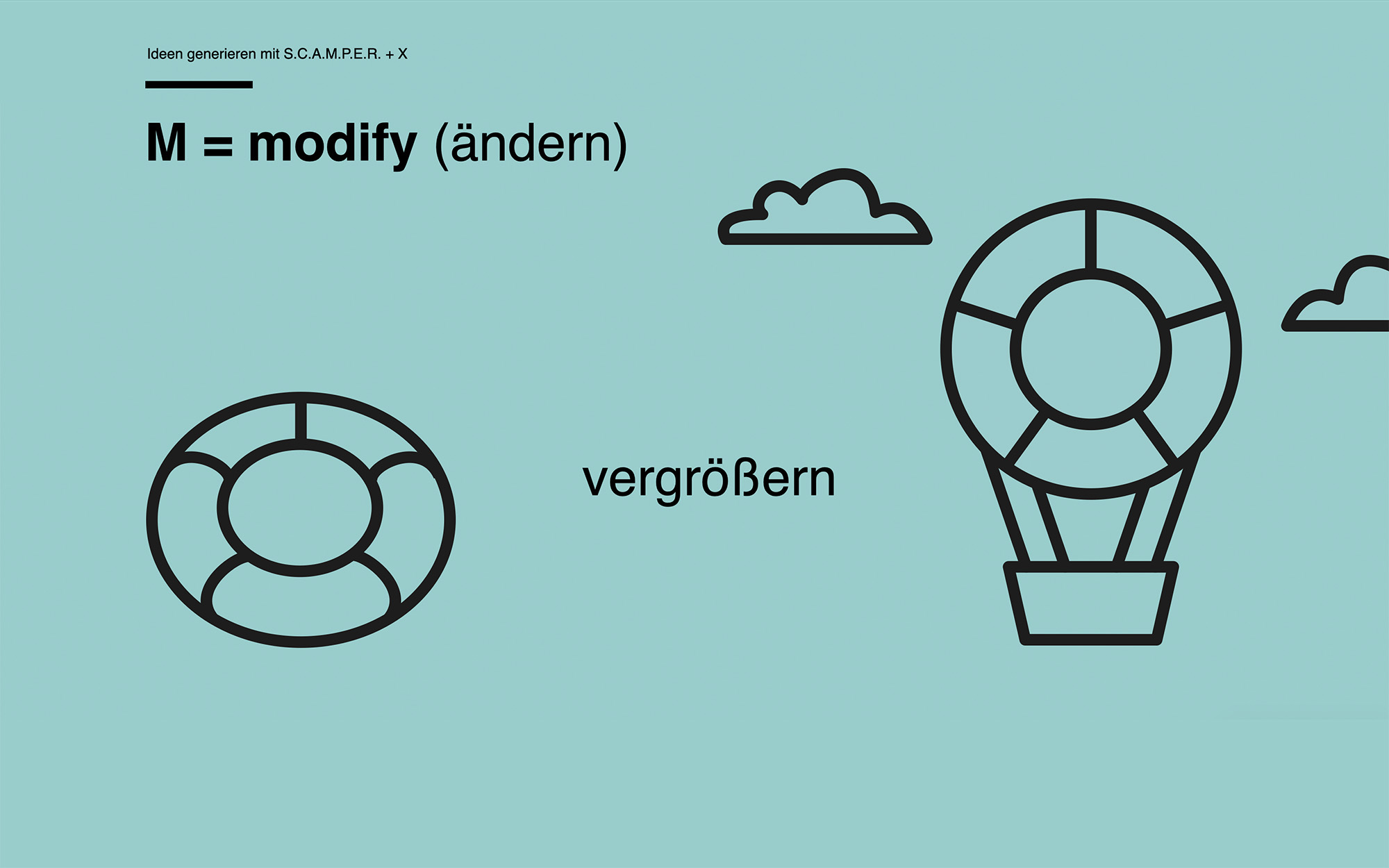
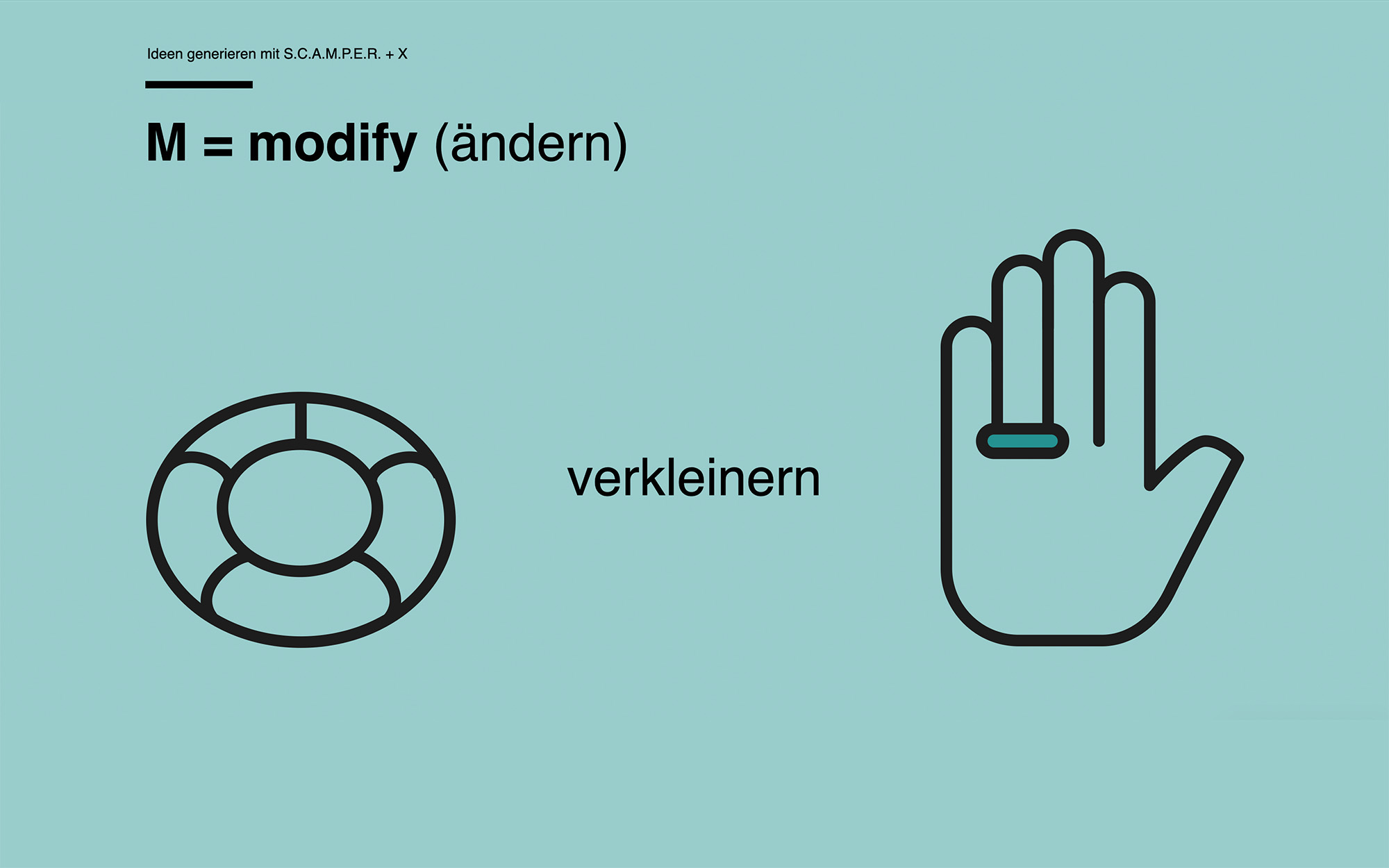
M stands for Modify. What changes can be made? Can its meaning be altered, or its colour changed? Can the idea be enlarged or reduced? Into a hot-air balloon or a finger ring?
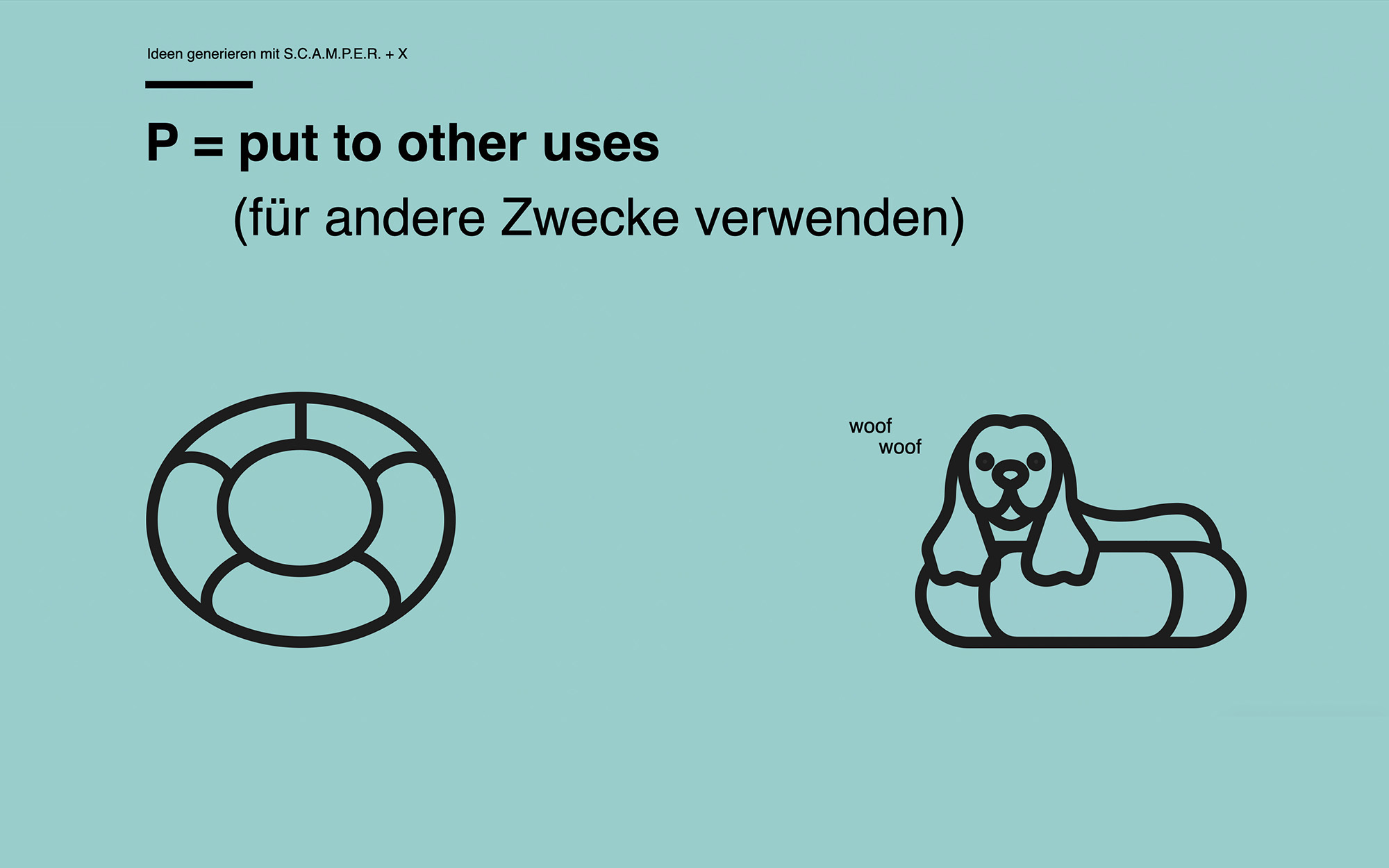
P stands for Put to other uses. What else could the product be used for in its current state? How might it be used if it were modified? As a dog bed?
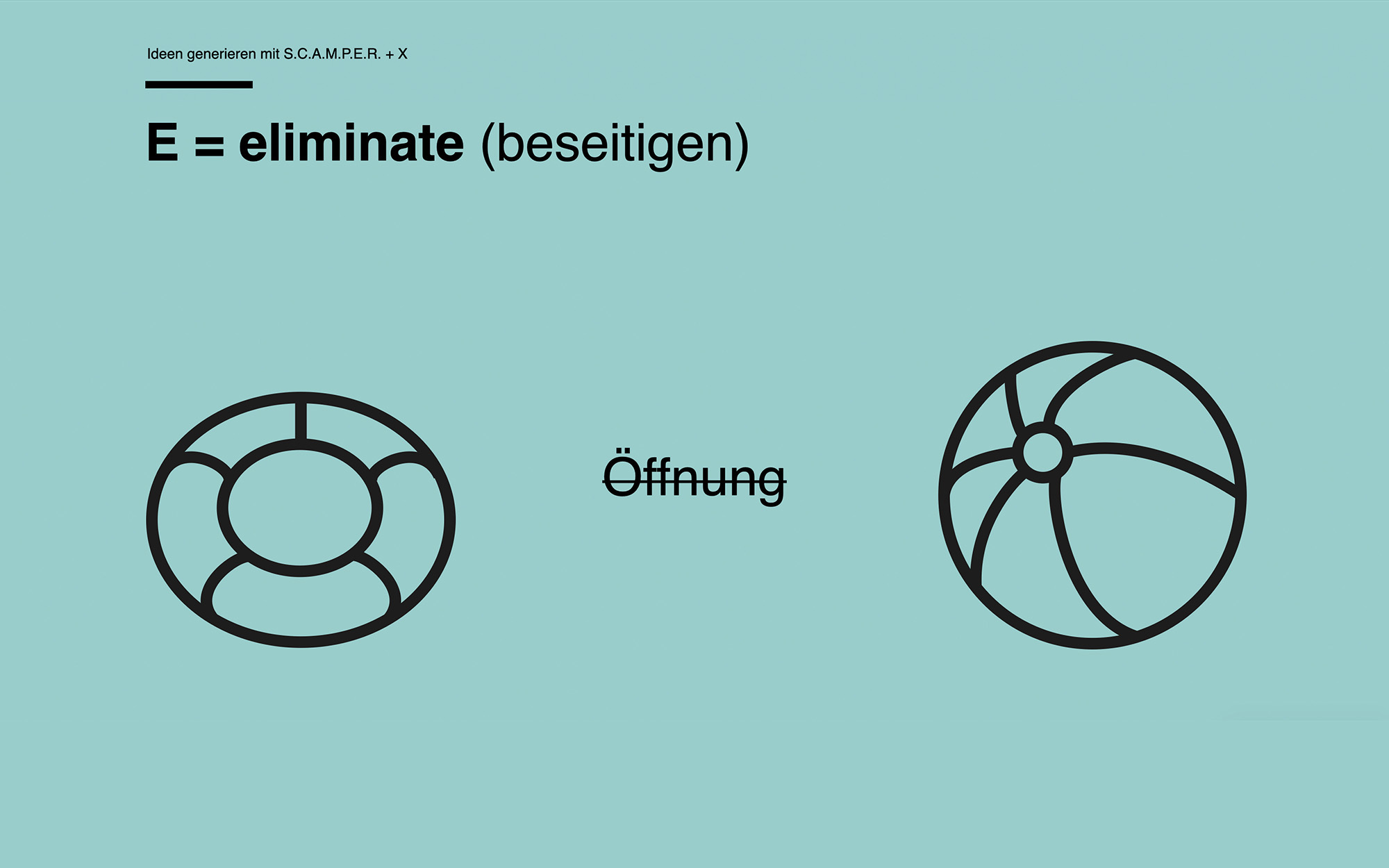
E stands for Eliminate. What could be removed? What is the object’s essential minimum? Without what would it still function? Without an opening, the swim ring becomes a ball.
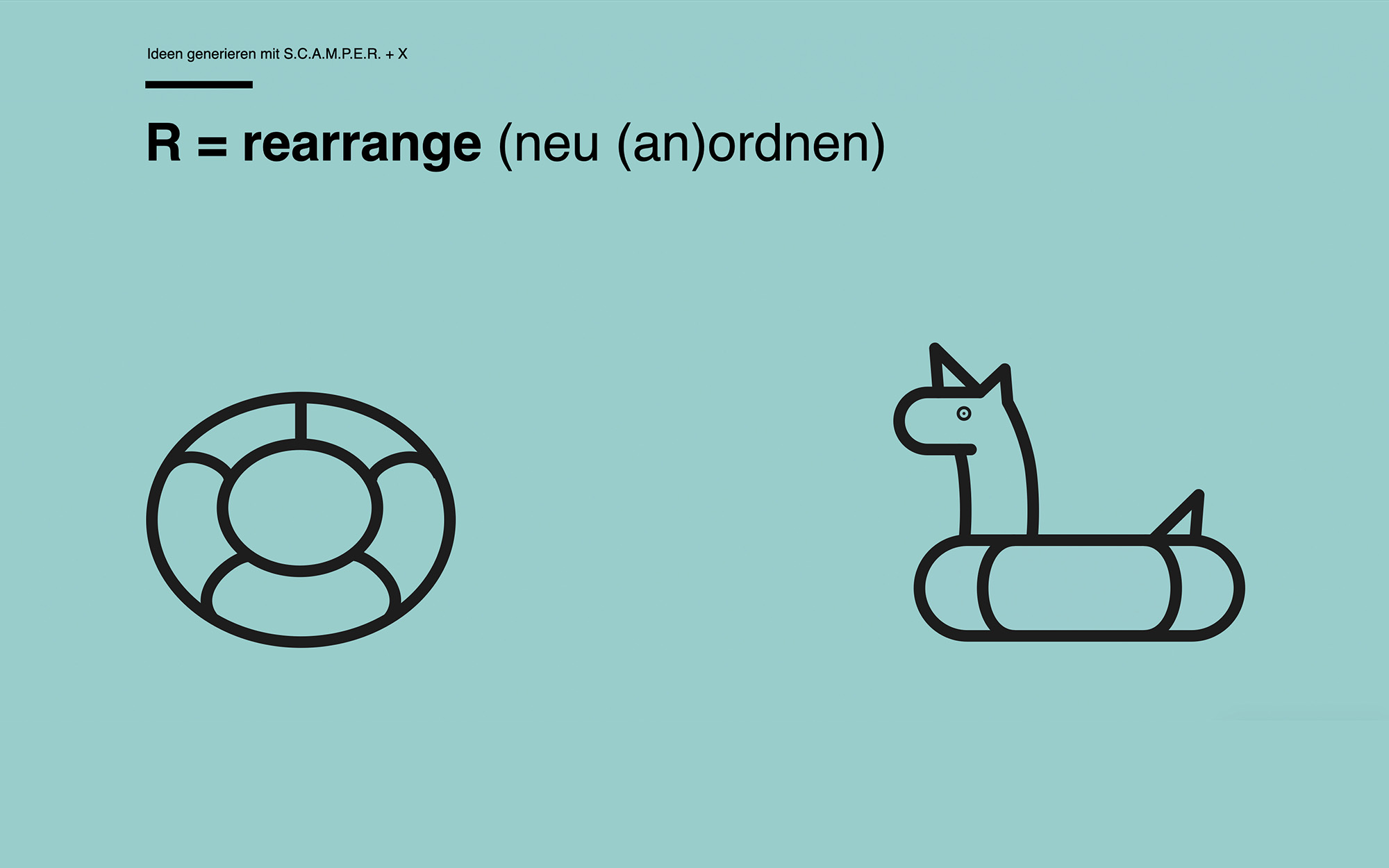
R stands for Rearrange. What other patterns could also work? What changes can be introduced? What can be swapped, added, or reorganized? The swim ring becomes a floating unicorn.
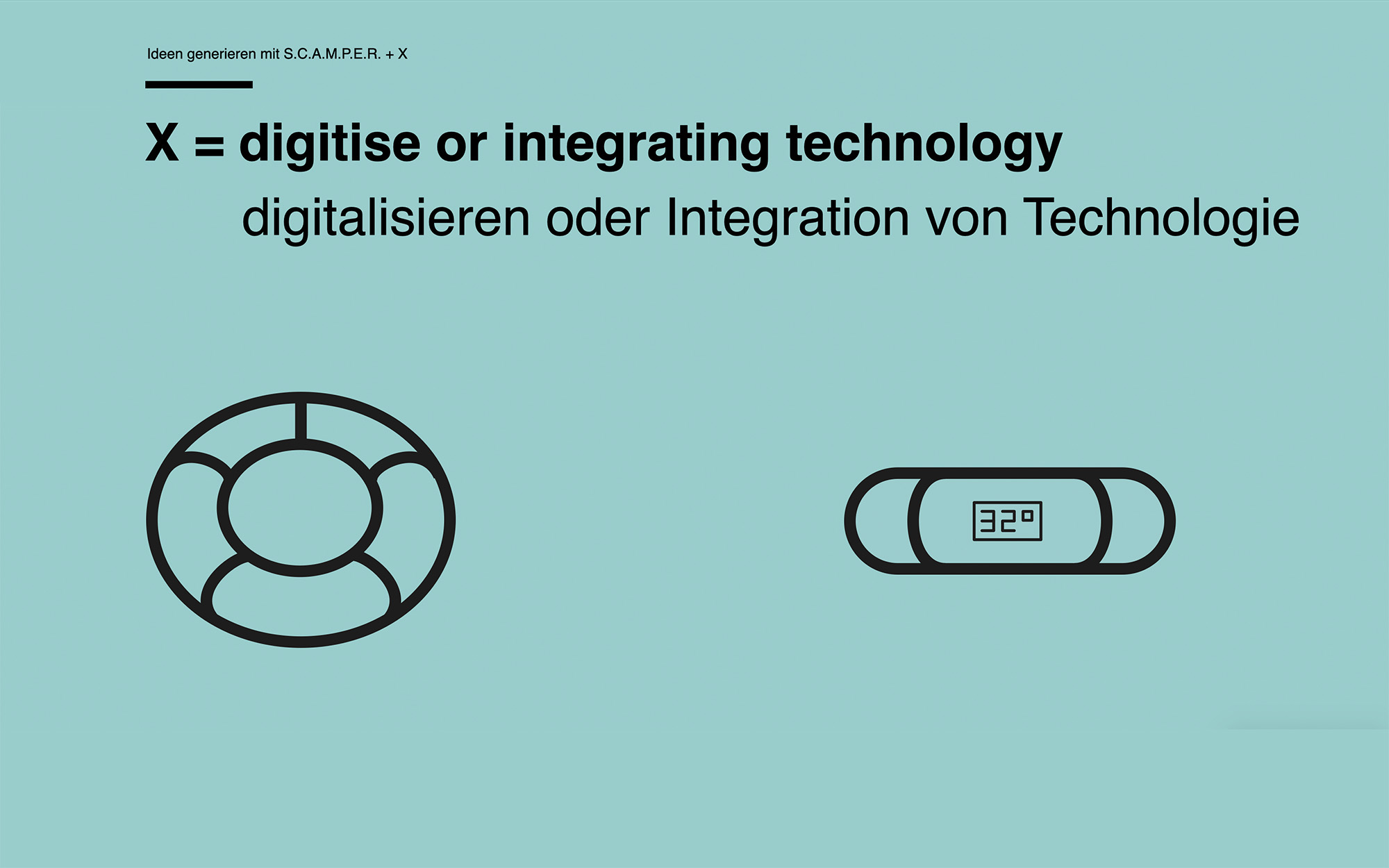
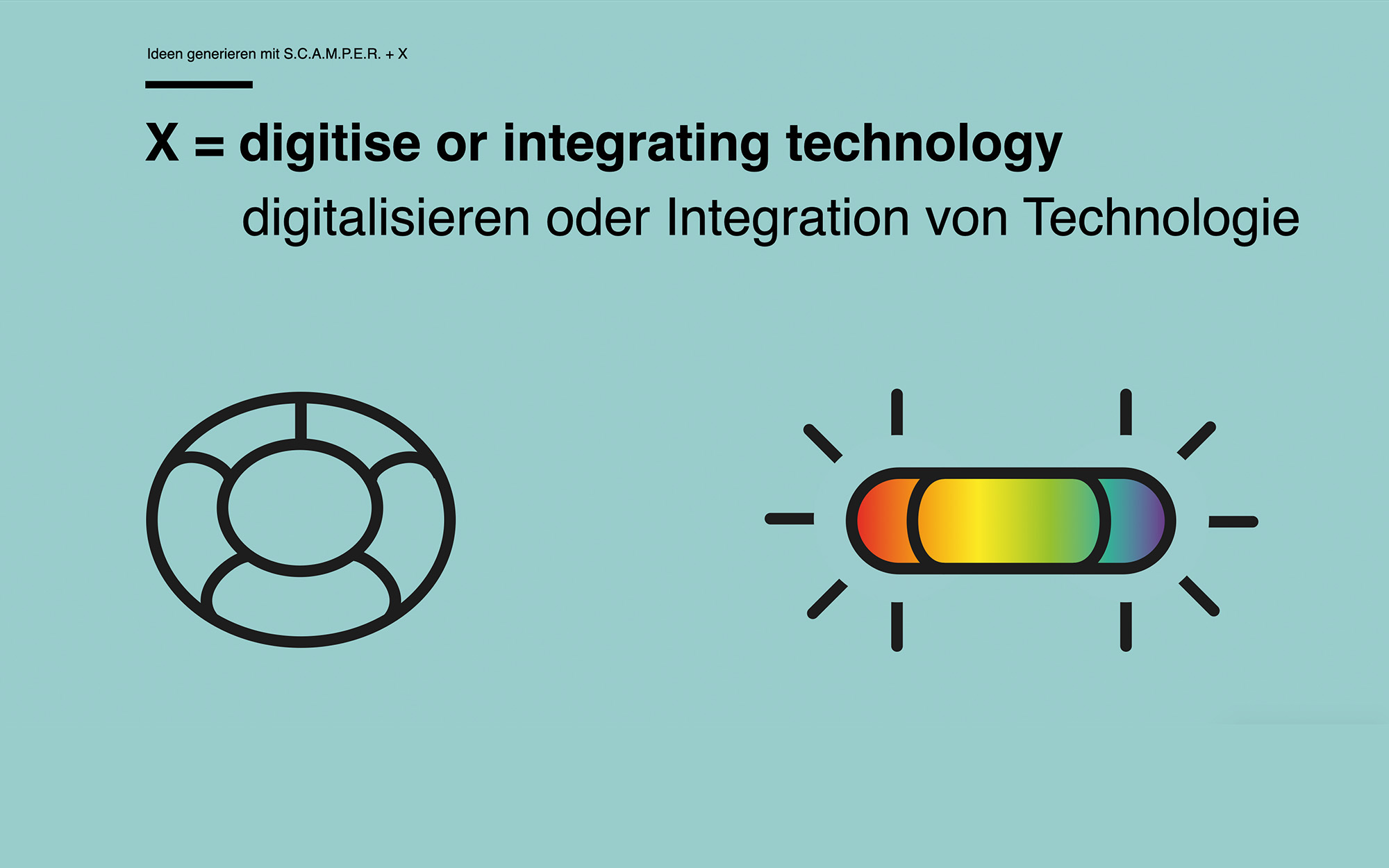
X stands for digitize. How can the idea be brought into the 21st century using technology? A sensor could measure the water temperature, or smart materials could visualize the user’s emotional state.
Result
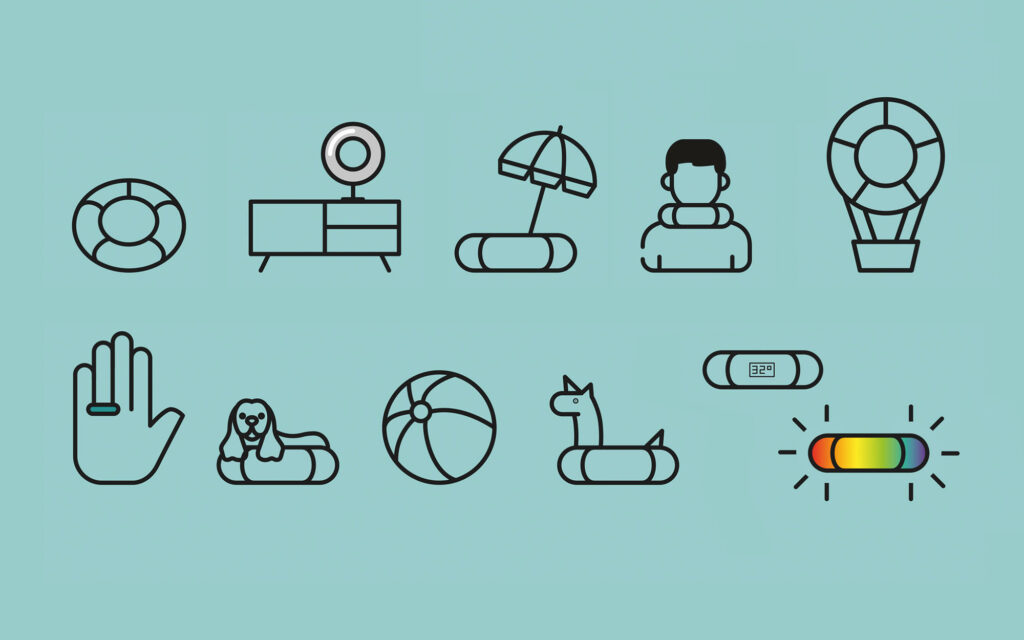
Looking at the outcome, we can see that applying these generative questions has produced ten additional ideas from a single starting point. This demonstrates the potential to significantly increase the quantity of ideas — and thereby the likelihood of developing something truly suitable.
Sometimes a question may not seem to fit — and that is perfectly fine. SCAMPER is not about completeness; rather, it is about stimulating thinking and setting a process in motion. Once the process is complete, the results can be reflected upon and further developed through additional questions.
In addition, after an intensive input phase, engaging in routine tasks or physical movement — such as going for a walk — can act as a powerful catalyst for creativity. Often, we find what we are looking for precisely when we are not searching for it.
Universities: RMIT, Vietnam / HTW, Berlin
Jahr: 2016 – 2020